
Amazon
Amazon · Automotive · Filed Jul 24, 2026 · USPTO published Nov 19, 2026 · This week's release
Amazon-Owned Zoox Patents Sensors That Vote on Whether the Road Is Clear
A self-driving car's cameras and other sensors can disagree about whether something is in the road. This Zoox patent application settles the argument with a vote.
- Publication number
- US 2026/0367635 A1(US20260367635A1)
- Applicant
- Zoox, Inc.
- Filed · Published
- Jul 24, 2026 · Nov 19, 2026
- Inventors
- James William Vaisey Philbin, Nicholas George Charchut, Noureldin Ehab Hendy, Cooper Stokes Sloan, Chuang Wang
- Status when we published
- Waiting for an examiner
- Document
- 20 claims
- US classification
- 701/26
- Parent application
- Continuation of 18/671,692 (filed May 22, 2024)(18671692)
What Zoox's sensor-voting backup actually does
Ever asked two friends whether a parking spot is really empty and gotten two different answers? You would want a rule for whose answer wins.
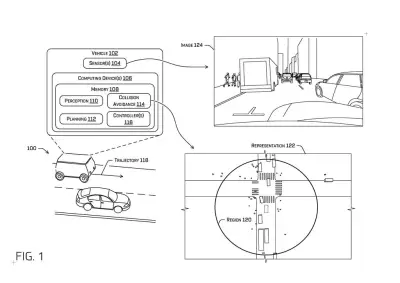
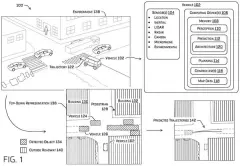
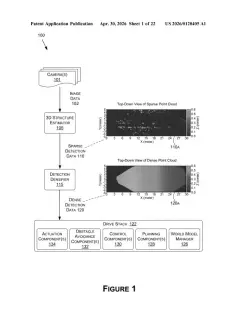
That is the situation this Zoox patent application describes for a self-driving car. The car has several kinds of sensors, such as cameras and lidar (a laser-based sensor that measures distance). Each kind gets its own AI model, and each model draws a top-down map of the area around the car, marking which squares look occupied. The system then combines those maps into one answer: is something there or not?
The car's driving plan is then checked against that answer. If the plan would carry the car too close to an occupied square, the car can slow down or stop instead of following it.
… determining, based at least in part on a technique, the first occupancy data, and the second occupancy data, a data structure indicating whether the region is occupied; and controlling an autonomous vehicle based at least in part on the data structure.
Translation: The car combines votes from different sensors into a single map to decide if the road is clear.
How Zoox merges two sensor maps into one
The claims cover a simple core idea. The system takes data from a first sensor and a second sensor, and for each one works out occupancy data (a yes-or-no or likelihood reading of whether a given region is occupied). It then combines the two readings into a single data structure and uses that to control the vehicle.
The description fills in the details. The data structure is an occupancy map, a grid where each square holds a confidence score (the likelihood that something is there). One example is a 30-meter by 30-meter square centered on the car, seen from above. The models can also predict ahead, for instance five maps spaced 500 milliseconds apart, from now out to 2 seconds.
The maps are combined with one of several techniques, and a threshold then turns scores into a plain occupied or unoccupied answer:
- Voting: majority, plurality, weighted (some sensors count more) or unanimity (all must agree).
- Averaging: simple or weighted averages of the confidence scores.
The check then runs on the car's planned path. The filing describes a threshold distance based on how far the car needs to stop at its current speed. If the path gets closer than that to an occupied square, the car follows a backup plan: slowing down, stopping safely or braking hard. The check can work from only a subset of the data the main perception system uses.
A collision avoidance system may validate, reject, or replace a trajectory generated to control a vehicle.
Translation: A backup safety system checks the car's planned path and overrides it if something goes wrong.
Why the voting rule sets how cautious a car is
The practical payoff is a second opinion on the car's driving plan. If the main system misjudges something, this separate check can still catch a plan that heads toward an obstacle. Because the sensors vote, one sensor's blind spot or false alarm is less likely to decide whether the car brakes.
The voting rule and threshold also work as a caution dial. The filing describes tuning them toward fewer missed objects, fewer false alarms, or a balance, and notes that a balanced setting helps avoid hard braking over something that is not there. For riders, that choice shows up as smoother or jerkier stops. The filing says this check can be more accurate than the main system and may use less computing power than earlier approaches.
That makes this Amazon's 37th filing we've tracked since May in our self-driving sensing race watchlist, following a parking-spot locator patent and a hazard-warning robotaxi filing.
Source: US 2026/0367635 A1 at the USPTO (PDF). Full patent text and figures are in the official publication.
Get our take in your Top Stories
Liked this breakdown? Add Patentlyze as a preferred source on Google, and our plain-English take shows up more often in your Top Stories the next time Amazon patent news breaks.
Add Patentlyze on Google
One click.
There are more where this came from
We read every patent application Big Tech publishes and send you the ones worth knowing. Plain English, free, every week.
The drawings · 5 sheets
5 drawing sheets from US 2026/0367635 A1 · click any drawing to enlarge


More from Amazon
All 114 Amazon patents →
More in Automotive
All 377 Automotive patents →
Sony
Sony Files Patent to Show Who Sent the Warning Projected on the Road
Nvidia
Nvidia Patents a Way to Keep Self-Driving Cars Clear of Roadside Obstacles
Tesla
Tesla Patent: Low-Cost Sensors Replicate Premium Ones Through Machine Learning Software
Nvidia
No comments yet