
Microsoft
Microsoft · AI / ML · Filed May 19, 2025 · USPTO published Nov 19, 2026 · This week's release
Microsoft Files Patent for AI Helpers That Take Turns Running One Chat
Most AI helper systems put one boss bot in charge and make it wait on the rest, so a single frozen helper can sink your whole chat. Microsoft's patent filing has the helpers pass the conversation along like a baton instead.
- Publication number
- US 2026/0367962 A1(US20260367962A1)
- Applicant
- Microsoft Technology Licensing, LLC
- Filed · Published
- May 19, 2025 · Nov 19, 2026
- Inventors
- Sanjay RAMANUJAN, Karthik RAMAN, Salman Mohammad QUAZI, Suriya Prakash KALIVARDHAN, Dharamendra KUMAR, Ravi Teja PIDAPARTHI
- Status when we published
- Waiting for an examiner
- Document
- 20 claims
- US classification
- 719/317
What Microsoft's take-turns AI helpers do
Imagine you're chatting with a company's help bot about a billing problem. You've answered a dozen questions: your name, your photo ID, your account details. Then one piece of software behind the scenes freezes, and the whole chat resets. You get to start over.
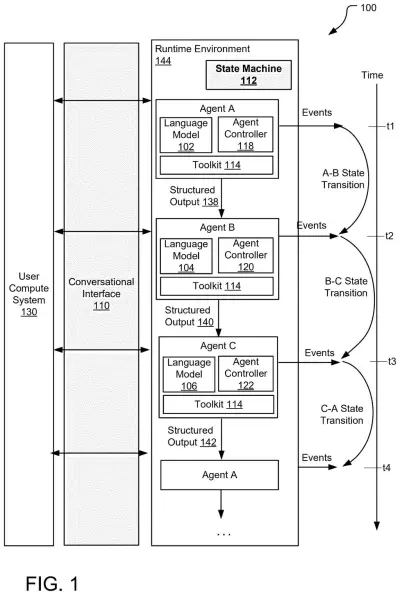
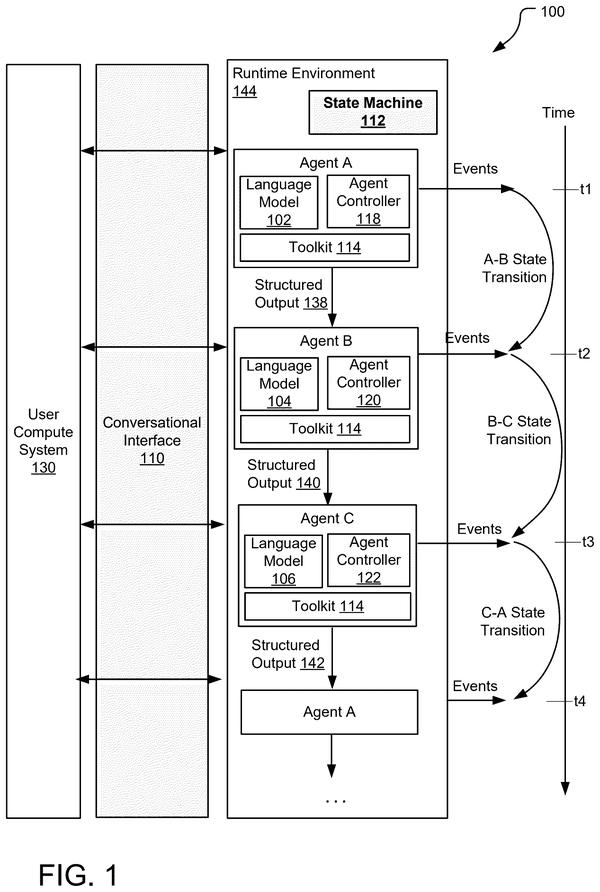
Microsoft's patent describes a different setup. Instead of one boss bot that hands jobs to helper bots and waits for them, the helpers take turns. A map of stages decides who is talking to you at any moment, such as an ID-checking helper first and a billing helper next. When a stage ends, the next helper takes over and receives the details it needs.
If a helper fails, the system rewinds to the last handoff instead of wiping everything. You might repeat one answer instead of twelve.
… designating an agent control group comprising one or more agents selected from the plurality of agents that is responsible for acting on inputs received through the conversational interface while the state machine is in the select state …
Translation: Assigning specific AI helpers to handle user messages during certain phases of the chat.
How Microsoft's chat handoff rules are set up
The claims cover a way for a developer to build a team of AI agents (programs that pair a language model with a set of software tools) through a programming interface. The developer lists the agents, then defines a state machine, which is a rulebook of the stages a conversation can be in and what moves it from one stage to the next. Each stage names an agent control group: the one or more agents in charge of the chat while that stage is active.
Each transition between stages names the old stage, the new stage, and the transition criteria, the conditions that trigger the switch. At runtime, the agents hand the conversation to one another using a flat control structure, meaning no agent is the parent of another and none sits waiting on a helper's result. The active group watches the chat, checks the criteria, and passes along structured data that names the old and new stages.
Each condition or variable also carries an evaluation mode. It can be rule-based (deterministic, so the same input always gives the same answer) or prompt-based (a language model judges it). The filing's example: a customer account number is set by rules, while a friendly nickname for the customer can be left to the model.
Each handoff also acts as a checkpoint. If an agent freezes, it restarts and repeats the last transition, so only its own recent work is lost.
… selectively transfer control of the conversational interface among the agent control groups defined for different states as state transitions are triggered by satisfaction of the transition criteria …
Translation: Passing the conversation to a new set of helpers when the chat reaches a certain point.
Why a frozen AI helper may not wipe your chat
If you've ever answered a long string of support-bot questions only to be sent back to the start, this is the problem the filing targets. A rewind to the last handoff means a failure costs you one repeated answer, not the whole session.
The rules-versus-AI switch is the other practical piece. A company can require that something like "is this customer actually authenticated?" is decided by fixed rules, so a made-up AI answer can't release someone's account data. The filing names the Azure AI Foundry portal as one place customers could define these workflows, which points at a tool for business developers.
That makes this Microsoft's 53rd filing we've tracked since May in our AI models that work in teams watch, which already includes their fact-checking AI and mid-chat AI handoff applications.
Source: US 2026/0367962 A1 at the USPTO (PDF). Full patent text and figures are in the official publication.
Get our take in your Top Stories
Liked this breakdown? Add Patentlyze as a preferred source on Google, and our plain-English take shows up more often in your Top Stories the next time Microsoft patent news breaks.
Add Patentlyze on Google
One click.
There are more where this came from
We read every patent application Big Tech publishes and send you the ones worth knowing. Plain English, free, every week.
The drawings · 4 sheets
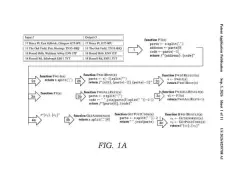
4 drawing sheets from US 2026/0367962 A1 · click any drawing to enlarge


More from Microsoft
All 681 Microsoft patents →
More in AI / ML
All 2,738 AI / ML patents →
Adobe
Adobe Wins a Patent for Two AIs That Take Turns Editing and Critiquing Your Video
Adobe
Adobe's New Patent Turns a Single Description Into a Finished, Ready-to-Use Page
Salesforce
A New Salesforce Patent Lets One AI Check Another's Work While It's Still Working
Samsung
No comments yet