
Microsoft
Microsoft · Software · Filed Apr 27, 2026 · USPTO published Nov 19, 2026 · This week's release
Microsoft Files Patent for a Voice Assistant That Starts Answering Before You Finish Talking
Your voice assistant usually waits for you to stop talking before it starts thinking. Microsoft's patent application has it start on a half-finished request, then keep that answer only if the rest of your sentence changes nothing.
- Publication number
- US 2026/0367696 A1(US20260367696A1)
- Applicant
- Microsoft Technology Licensing, LLC
- Filed · Published
- Apr 27, 2026 · Nov 19, 2026
- Inventors
- Chun Hin Nelson SIU, Hosam Adel KHALIL, Ajoy NANDI, Carmen QUAN, Denis FISENKO, Md Nizam Uddin CHY, Min HU, Christopher Hakan BASOGLU, Sayan Dev PATHAK
- Status when we published
- Waiting for an examiner
- Document
- 20 claims
- US classification
- 345/156
- Parent application
- Continuation of 18/999,788 (filed Dec 23, 2024)(18999788)
What Microsoft's answer-early assistant does
Right now, a voice assistant or search box waits until you are completely done before it starts working on your request. Whatever time the answer takes to produce, you sit through all of it.
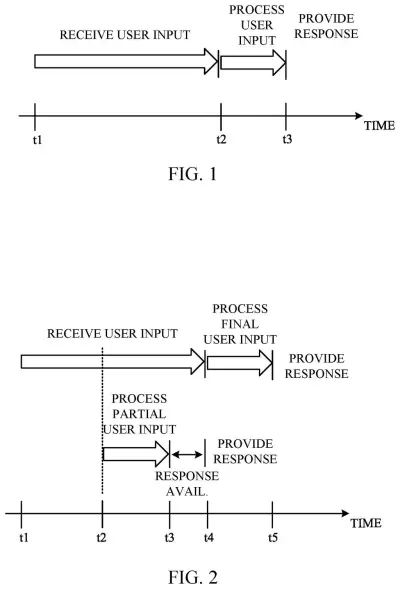
This Microsoft patent application describes getting a head start. While you are still speaking or typing, the software grabs the part you have said so far and begins working on it, such as what is the weather forecast. If the rest of your sentence adds nothing new, the answer is already waiting and appears the moment you finish.
If you add something that changes the request, like a person's name on a meeting invite, the early answer gets thrown away and the system starts over with your full request.
receiving a first partial user input that is a first portion of a final user input; in response to detecting a first triggering condition, causing the first partial user input to be processed; receiving a first response that is based on the first partial user input, wherein the first response is a candidate response for the final user input; …
Translation: The system starts working on an answer before you even finish your sentence.
How the assistant decides when to jump in early
The system watches your request as it arrives, whether you speak it, type it or gesture it. When it detects a triggering condition (a signal that the request so far might be enough to act on), it treats everything received up to that point as a partial input and sends it off for processing while you keep going.
The filing lists several possible triggers:
- A pause in your speech or typing, with the 200 to 250 millisecond gaps a human ear can notice given as a reference point
- A particular word or phrase
- A prediction that you are saying a common request, such as turn off the while music plays
- Eye tracking showing you looked away from the text box
The resulting answer is stored (cached) as a candidate. When you finish, a comparison step decides whether the partial request is equivalent to the full one. It can use a classifier (a trained program that sorts things into categories) for this. If they match, the stored answer is shown. If not, the full request is processed fresh. Several partial inputs can be tried along the way, each replacing the last.
The triggers can be tuned. The filing describes allowing longer pauses for children, people who stammer, and certain regions or accents. It also says a partial request can prepare another app, such as a weather service, ahead of time.
After the final user input is received, and if the partial user input is determined to match or be equivalent to the final user input, the first response, which is already available, is provided to one or more output devices for presentation.
Translation: If its early guess was right, the assistant uses the answer it already prepared.
Why a few hundred milliseconds matter to you
If this ever shipped in an assistant or search box, you would feel it on everyday requests like turning off music, checking the weather or setting a reminder. The filing's own example shows the math: if an answer takes 500 milliseconds to produce and processing starts 300 milliseconds early, you wait only 200.
The filing also puts effort into timing the guess correctly. It adjusts for age, fluency, accent and region, which matters if an assistant is meant to work for everyone, including children and slower talkers. The filing names Microsoft Cortana as an example assistant, and the same idea covers typed search boxes and other apps.
That makes this Microsoft's 681st filing we've tracked in our Microsoft coverage since May, adding to work like the palm-rest touchpad and the tab-sharing AI.
Source: US 2026/0367696 A1 at the USPTO (PDF). Full patent text and figures are in the official publication.
Get our take in your Top Stories
Liked this breakdown? Add Patentlyze as a preferred source on Google, and our plain-English take shows up more often in your Top Stories the next time Microsoft patent news breaks.
Add Patentlyze on Google
One click.
There are more where this came from
We read every patent application Big Tech publishes and send you the ones worth knowing. Plain English, free, every week.
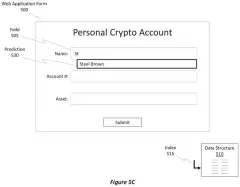
The drawings · 11 sheets
11 drawing sheets from US 2026/0367696 A1 · click any drawing to enlarge


Show the other 3 sheets


More from Microsoft
All 681 Microsoft patents →
More in Software
All 814 Software patents →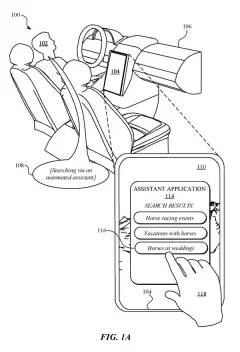
Google
Google Files Patent to Delay Assistant Updates Until You Finish Editing Settings
Apple
Apple Files Patent for Voice Assistant Replies That Fit Around Your Phone's Camera Cutout
Samsung
Samsung Patents Screenshots That Automatically Remove the Voice Assistant Overlay
Google
No comments yet