
Qualcomm
Qualcomm · Networking · Filed Jun 3, 2025 · USPTO published Nov 19, 2026 · This week's release
Qualcomm Files Patent for a Phone That Uses Echoes to Pin Down Your Location
Qualcomm's patent application has your phone send out sounds you can't hear, then listen to the echoes to work out whether it's boxed in by skyscrapers or standing in an open park.
- Publication number
- US 2026/0367246 A1(US20260367246A1)
- Applicant
- QUALCOMM Incorporated
- Filed · Published
- Jun 3, 2025 · Nov 19, 2026
- Inventors
- Yuxiang PENG, Jason FILOS, Ning LUO
- Status when we published
- Waiting for an examiner
- Document
- 20 claims
- US classification
- 455/456.1
- Parent application
- National Stage Entry of PCT/US2023/082733 (filed Dec 6, 2023)(PCTUS2023082733)
What Qualcomm's echo-based location idea does
Imagine you're walking down a street lined with skyscrapers, and the blue dot on your map keeps drifting into the building next to you. Tall buildings block and bounce satellite and cell-tower signals, so your phone can't always tell which readings to trust.
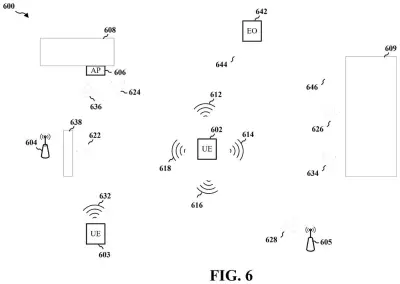
This Qualcomm patent application has your phone listen to its surroundings to help. The phone sends out a sound pitched above what people can hear, then picks up the echoes with its microphones. How many echoes come back, how loud they are and how long they linger give the phone a rough picture of the place: open park, suburban street, packed city block or the inside of a room.
With that picture, the phone changes how much it trusts each location signal. If the echoes show a wall sitting between it and a cell tower, it can ignore or downplay that tower's signal.
receive an audio wave (AW) echo, wherein the AW echo comprises an echo of at least one previous AW; determine an echo profile based on the received AW echo; and determine a position of the UE based on the echo profile.
Translation: The phone listens for sound bounces to map out an echo profile and figure out where it is.
How the phone reads echoes to pick a mode
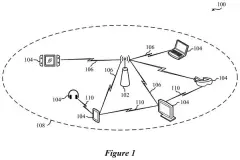
Your phone (a "user equipment," or UE, in patent language) plays a sound through its speaker and records the echoes with its microphones. From those it builds an echo profile: how many echoes came back, how loud each one was, and how fast the reverberation faded.
A step called acoustic context detection (software that guesses what kind of place a sound came from) turns the profile into scene details, such as obstacle size, location and even material. Outside sounds count too: many car horns suggest a dense city, while birds suggest a park.
The phone then picks a mode for its positioning engine (the software that turns radio signals into a location):
- Free field: few obstacles
- Suburban: many obstacles
- Indoor: close obstacles
- Deep urban: many obstacles plus lots of interfering devices
The modes differ in how they update a position over time and in the noise setting of a Kalman filter (a math routine that blends shaky readings into one best guess). The filing's example uses 1 for free field and 10 for deep urban.
The phone can also send sound in different directions, one after another, much like a simple radar. If a direction looks blocked, it can discard or down-weight signals from that way.
… perform acoustic context detection (ACD) to calculate acoustic scene parameters based on the echo profile.
Translation: It analyzes the echoes to understand the acoustic characteristics of the surrounding room.
Why echo clues could help city navigation
Location apps struggle most in dense downtowns and inside buildings, where signals bounce off walls. Echoes give your phone an extra clue about which signals to trust, which could mean a steadier dot when you are walking to a restaurant or hunting for a pickup spot.
The filing lists phones, vehicles, robots and other connected gadgets as possible devices, and it also ties the echo readings to satellite-based positioning. It is a patent application, so nothing here says a product is coming, and the text gives no accuracy numbers.
This is the 635th Qualcomm filing in our Qualcomm coverage since May, a run that includes applications like the self-driving spacing AI and nod-to-answer earbuds.
Source: US 2026/0367246 A1 at the USPTO (PDF). Full patent text and figures are in the official publication.
Get our take in your Top Stories
Liked this breakdown? Add Patentlyze as a preferred source on Google, and our plain-English take shows up more often in your Top Stories the next time Qualcomm patent news breaks.
Add Patentlyze on Google
One click.
There are more where this came from
We read every patent application Big Tech publishes and send you the ones worth knowing. Plain English, free, every week.
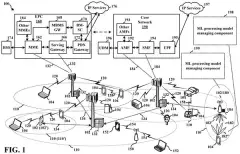
The drawings · 11 sheets
11 drawing sheets from US 2026/0367246 A1 · click any drawing to enlarge


Show the other 3 sheets


More from Qualcomm
All 637 Qualcomm patents →
More in Networking
All 516 Networking patents →
Qualcomm
Qualcomm Files Patent for Wi-Fi That Can Tell a Game From a Video Call
Intel
Intel Files Patent for Keeping Neighboring Cell Towers From Drowning Out Each Other's Radar
Qualcomm
Qualcomm Patents Phones That Use Radio Signals as Radar and Report Back in Plain Words
Qualcomm
No comments yet