
Samsung
Samsung · Software · Filed May 8, 2026 · USPTO published Nov 19, 2026 · This week's release
Samsung Files Patent for Fewer Glitches in 3D Scenes Built From Photos
Rebuild a 3D scene from a few photos and the computer has to guess everything the camera never saw. Samsung's new patent application adds a relevance check to every pixel to cut the glitches that guessing leaves behind.
- Publication number
- US 2026/0368969 A1(US20260368969A1)
- Applicant
- Samsung Electronics Co., Ltd.
- Filed · Published
- May 8, 2026 · Nov 19, 2026
- Inventors
- Xingyi LI, Yangwen LIANG, Kee-Bong SONG, Donghoon KIM
- Status when we published
- Waiting for an examiner
- Document
- 20 claims
- US classification
- 345/619
- Parent application
- Claims priority from a provisional application 63803442 (filed May 9, 2025)
What Samsung's pixel relevance check does
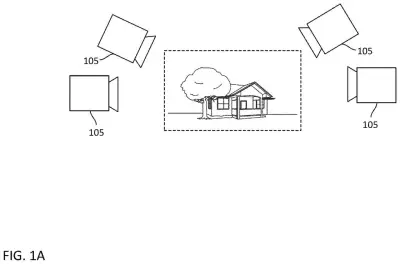
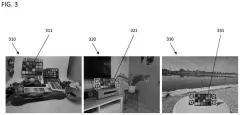
A phone camera circles a building and snaps a few dozen photos. Later, someone wants to see that building from a spot where no photo was taken, such as across the street at a new angle.
Computers can do this by building a 3D model out of thousands of tiny, fuzzy blobs, then working out what a camera would see from any new position. The catch is that each blob is often judged on its own. In scenes with complicated shapes or objects blocking each other, that can leave odd shading and visible glitches.
Samsung's filing adds a relevance check. For every pixel on screen, the system asks how well each blob matches that pixel's position and direction. It gives good matches more say in the pixel's color and turns down the ones likely to cause glitches. For you, that could mean cleaner AR, VR or game views built from ordinary photos.
calculating a contribution from a first scene element, the contribution being based on: an opacity function of the first scene element; a color of the first scene element; a transmittance of a second scene element; and a first attention coefficient …
Translation: The system calculates how much light and shadow each object in the scene contributes to the final picture.
How each 3D blob gets scored against a pixel
The patent builds on a method called Gaussian splatting. A 3D scene is stored as a cloud of soft, fuzzy blobs (the filing calls them Gaussian ellipsoids), each with a position, a size along each direction, a rotation, a color and an opacity. To draw one pixel, the renderer adds up the light from the blobs along that line of sight.
Each blob's share depends on its color, its opacity (how much light it blocks) and the transmittance of blobs in front of it (how much light still gets through them). The claims add one more ingredient: an attention coefficient, built from a similarity score between the blob and the pixel.
To get that score, a blob is described by nine numbers (three for position, three for rotation, three for relative size), and the pixel gets a matching nine-number description. Each is stretched into a longer list by a learned linear transformation (a grid of multipliers, such as 16 by 9). A dot product (a single score for how well two lists line up) is then normalized so the scores across blobs add up to a constant.
The multipliers and the blobs are learned from photos labeled with where the camera stood. The system draws test images, measures the gap from the real photos, and uses backpropagation (nudging numbers to shrink the error). For speed, the image is split into 16 by 16 pixel tiles and only nearby blobs are checked, so the work can run in parallel on a graphics chip.
… a first attention coefficient, the first attention coefficient being based on a first measure of similarity between attributes of the first scene element and attributes of the pixel.
Translation: It decides which parts of the 3D scene match up best with what the camera is supposed to see.
What this means for AR, VR and game graphics
If you wear a headset or play a game that shows a real place rebuilt from photos, glitches like odd shading and mismatched surfaces break the effect fast. The filing names augmented reality, virtual reality, game development and medical imaging as places where this rendering is useful, and it says attention-based weighting may raise image quality.
It also says the extra step can keep real-time speeds on graphics hardware. The filing gives no test numbers, so how much it improves anything is unproven. It is a patent application, and nothing in it says the idea will land in a Samsung product.
That makes this Samsung's 178th filing we've tracked in our camera sensor push since May, adding to work like the sky and plant color fix and per-channel color handling.
Source: US 2026/0368969 A1 at the USPTO (PDF). Full patent text and figures are in the official publication.
Get our take in your Top Stories
Liked this breakdown? Add Patentlyze as a preferred source on Google, and our plain-English take shows up more often in your Top Stories the next time Samsung patent news breaks.
Add Patentlyze on Google
One click.
There are more where this came from
We read every patent application Big Tech publishes and send you the ones worth knowing. Plain English, free, every week.
The drawings · 6 sheets
6 drawing sheets from US 2026/0368969 A1 · click any drawing to enlarge


More from Samsung
All 1,662 Samsung patents →
More in Software
All 814 Software patents →
Samsung
Samsung Files Patent to Shrink Video Files With an Extra Compression Step
Samsung
Samsung Files Patent to Stop Phone Cameras From Reading Stacked Words as Gibberish
Samsung
Samsung Files Patent to Squeeze Better Video Out of Phone Chips Without More Power
Samsung
No comments yet