
Sony
Sony · Networking · Filed Mar 2, 2026 · USPTO published Nov 19, 2026 · This week's release
Sony Files Patent for Using Nearby Phones as Radar to Pinpoint Things Indoors
Sony describes a way to find something indoors by having several nearby phones each send a signal at it and listen for the echo. The idea is to cover the places where GPS gives up.
- Publication number
- US 2026/0367237 A1(US20260367237A1)
- Applicant
- Sony Group Corporation
- Filed · Published
- Mar 2, 2026 · Nov 19, 2026
- Inventors
- Haojin LI, Wangjun JIANG, Chen SUN
- Status when we published
- Waiting for an examiner
- Document
- 20 claims
- US classification
- 342/146
- Parent application
- National Stage Entry of PCT/CN2024/123366 (filed Oct 8, 2024)(PCTCN2024123366)
What Sony's phone-powered indoor tracking does
Inside a big building, GPS often gives up on you. Walls and ceilings block the satellite signal. The cell-tower methods phones use as a backup need a clear line between your phone and the tower, and indoor clutter tends to break it. Special sensors like LiDAR can fix the accuracy, but they cost too much to install everywhere.
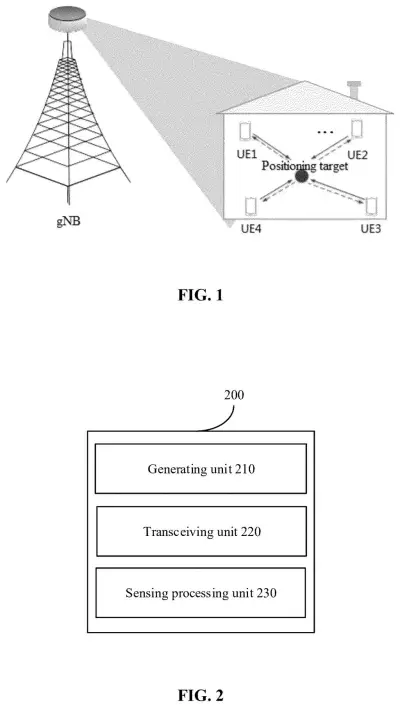
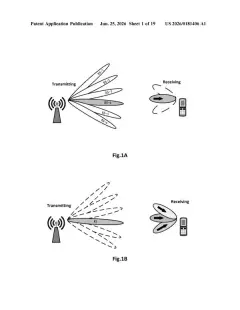
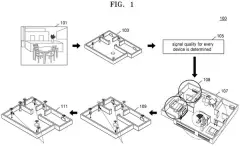
Sony's patent application describes a different route: use the crowd of devices already nearby. A base station (the radio hub that connects phones to the network) would ask several devices close to the thing being located to each send a signal toward it and listen for the echo, a bit like a bat chirping in the dark.
Each device reports what it heard back, and the base station blends the reports into one location. The filing says the goal is high accuracy at relatively low cost, even where buildings get in the way.
transmit a positioning instruction to each of a plurality of terminal devices near a positioning target to instruct the terminal device to transmit a sensing signal to the positioning target and receive an echo signal to obtain sensing data …
Translation: The main device tells nearby phones to bounce signals off the target item and gather the results.
How nearby phones ping a target and compare echoes
The filing covers three connected pieces: a controller (usually a base station, though the filing says a phone could play this role), the nearby devices, and the method that ties them together.
The controller sends each nearby device a positioning instruction. It can include the target's rough position, which direction to aim the beam, when to send, what format to report in, and how often to repeat. Each device then sends a sensing signal at the target, listens for the echo (the part that bounces back), and reports data such as echo strength, signal quality, and the angle and distance to the target.
The controller then cleans up the pile of reports:
- Drop reports with weak or noisy echoes.
- Pick devices whose angles and echo strengths cover the widest spread, using a geometry idea called a convex hull (the outer boundary around a set of points), so fewer devices give nearly the same accuracy.
- Blend the rest, giving more weight to stronger echoes, either by averaging each device's estimate or by overlapping each device's zone of uncertainty.
The process can repeat on a timer, with each new location fed back so devices aim better next round. The filing describes starting it when the target asks, or when its current accuracy drops below a threshold.
… process the received sensing data to obtain a positioning result of the positioning target …
Translation: The system combines all the phone data to calculate the exact location of the item.
Why Sony is going after indoor dead zones for GPS
If this worked as described, finding a person or object inside a building could get more accurate without every building installing its own tracking hardware. The filing leans on devices that are already in the room and connected to the network, which is where the low-cost claim comes from.
The design also tries to avoid draining those devices. A base station can first ask each one, with a simple two-bit status message, whether it has spare radio capacity and is not busy with other tasks. It can also pick only the most representative devices to cut the processing load. Like any patent application, this describes an idea on paper, and the text names no product.
That makes this Sony's 712th filing we've tracked in our Sony coverage since May, adding to work like the ultra-fast camera speed patent and the controller click mute patent.
Source: US 2026/0367237 A1 at the USPTO (PDF). Full patent text and figures are in the official publication.
Get our take in your Top Stories
Liked this breakdown? Add Patentlyze as a preferred source on Google, and our plain-English take shows up more often in your Top Stories the next time Sony patent news breaks.
Add Patentlyze on Google
One click.
There are more where this came from
We read every patent application Big Tech publishes and send you the ones worth knowing. Plain English, free, every week.
The drawings · 13 sheets
13 drawing sheets from US 2026/0367237 A1 · click any drawing to enlarge


Show the other 5 sheets


More from Sony
All 722 Sony patents →
More in Networking
All 516 Networking patents →
Google
Google Patent Reveals Nearby Phones Jointly Training a Shared AI Model
Samsung
Samsung Patents Tech That Lets Phones Find Nearby Devices on Two Separate Wireless Networks Simultaneously
Qualcomm
Qualcomm Files Patent for Phones That Change How They Locate You by Area
Samsung
No comments yet