
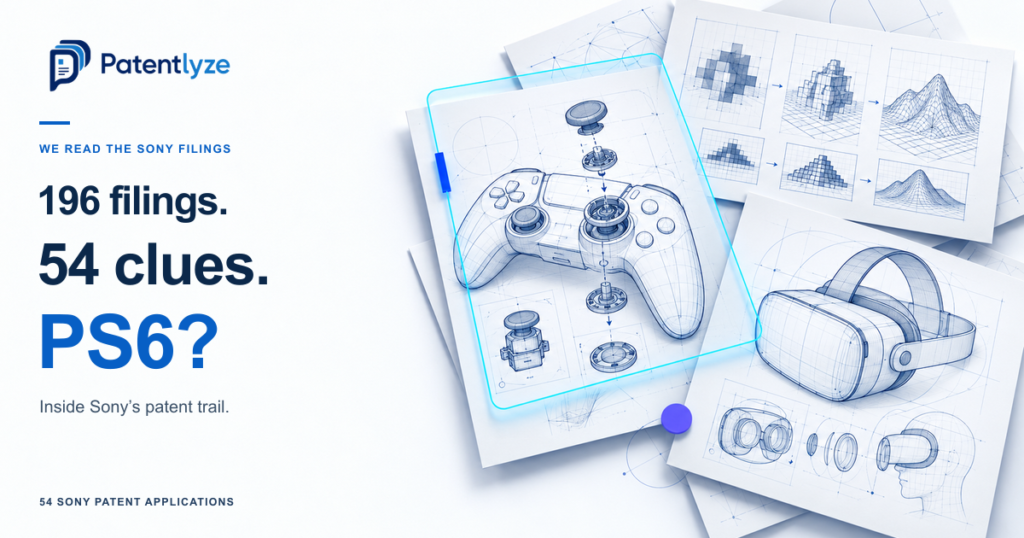
Sony hasn’t announced the PlayStation 6. There’s no date, no price and no spec sheet. In May, Sony CEO Hiroki Totoki said the company had not decided when to launch its next console or what to charge, and in August he told The Wall Street Journal the date still wasn’t set.
Reports are all over the map. Bloomberg reported in February that Sony was weighing 2028 or 2029 because of memory shortages. Ampere Analysis expects late 2028, and a September leak, unconfirmed, points to November 2027. Stevivor keeps a running list of every Sony comment and leak.
Patent filings are a different kind of evidence. Patentlyze has covered 196 filings from Sony Interactive Entertainment, the Sony company behind PlayStation, published between May 14 and October 22, 2026. We read all of them. These 54 line up with what Sony has said or with the PS6 reporting.
One caution first: Sony never says which filings are meant for which product, and many patented ideas never ship (here is how Big Tech patents work). None of these filings names the PS6. Read them as a map of what Sony’s engineers are working on, not a parts list.
PS6 patents: the short version
- Controller (15 filings): a grip with a moving weight that pushes back, magnetic buttons, a dial with a touchscreen, stick drift fixes, slide-out sticks and a solar-powered controller.
- AI graphics (11): machine learning that sharpens game frames, predicts new ones and handles textures. This is the biggest cluster.
- Beyond the living room (5): games shown on smaller screens, a phone controller and touch controls.
- Console plus cloud (6): your console and Sony’s servers splitting the graphics work.
- System software (6): faster boots, fewer load screens and patches that install while you play.
- AI helpers (6): a coach, a settings assistant and an AI that plays for you.
- VR (5): better headset tracking and safety features.
- Status: none has been granted. All are applications still working through the patent office.
PS6 controller patents: new ways to feel the game
The DualSense’s haptics and adaptive triggers were the PS5’s most talked-about hardware features, and Sony keeps filing controller ideas. Nine filings published since May describe new sensations, new inputs and new jobs for the controller.
A grip with a weight that pushes back
A filing published June 4 describes a controller with a grip and a separate section attached through a joint. Inside that section, a weight moves relative to the joint, and the shift reaches your hand as a push or a pull.
The description gives examples such as feeling inertia push against your movement, or a sense of weight as you turn a lever or open a door in a game. That is a different sensation from rumble. The filing continues an international application Sony filed in August 2023.
Removable grip buttons held by magnets
A July filing replaces the springs under a button with magnets. One magnet holds the button in place and moves with it when pressed; a second pulls it back to where it started. The button can also be pulled off from outside the controller.
The example buttons sit on the grips, where your middle fingers rest, a spot close to the swappable back buttons on the DualSense Edge.
A dial with its own touchscreen
Another July filing describes an input with a small screen of icons and a part that turns, used to pick icons or control features. A dependent claim makes the screen a touchscreen. The description says the knob could take the form of a replaceable stick module, like the ones the DualSense Edge already uses.
Game sounds you can feel and see
A filing published October 22 sorts what a sound is meant to do, such as whether it is friendly or aggressive or just background, before it plays. It then adds a matching cue at the controller. The description mentions lights around the DualSense touchpad that point toward the sound.
The rest of this group:
- A reaction button: a physical button that sends a reaction, such as a like, while keeping another job in the game. It continues an application from October 2019, a year before the PS5 launched.
- Paying through the controller: the controller spots your phone nearby, and the phone passes payment details through the controller to the console.
- Idle controllers as speakers: controllers not in use get surround sound channels, which they play through their haptic motors.
- A covered speaker fix: the controller notices when its speaker is blocked and adjusts the sound.
- A spring-mounted speaker: an elastic mount that keeps controller audio sounding the same.
PS6 controller patents: stick drift, swappable sticks and solar power
Stick drift, when a controller registers movement nobody made, is one of the most common complaints about modern controllers, including the DualSense. Six filings deal with sticks, their wear and the controller’s power.
Sticks that slide out and swap
A filing published October 8 claims a stick unit with its own circuit board, a connector and a guide, all running front to back, so the whole unit slides in and out of the controller. The DualSense Edge already has replaceable stick modules; this is a different way to mount them.
A June filing covers the caps on top: they lock on at set positions, so the markings on a cap always line up with the directions the game reads.
Drift fixes for plug-in sticks
An August filing has the controller store the value a stick should report at rest. When the stick seems idle, the controller finds the reading that shows up most often and updates the stored value. In plain terms, it corrects small drift on its own.
The sticks here plug into a jack on the controller, and the description says the controller may be an accessibility controller. A May filing handles a similar setup: when several sticks, including plugged-in ones, are all at rest, a rule picks one to report. Sony’s Access controller already accepts plug-in accessories.
A June filing moves your stick sensitivity setting into the controller itself, which converts the stick’s position, adjusts it to your setting and sends the result to the console.
A controller charged by light
A June filing puts several solar cells inside the controller’s housing, feeding a built-in power store. The claim doesn’t say how much power they would supply. It continues an international application Sony filed in August 2023.
AI upscaling and frame generation: the strongest PS6 hint
This is the biggest cluster: 11 filings on using machine learning to make game images sharper, smoother or cheaper to store. It also matches the direction Sony has taken in public.
The PS5 Pro launched in 2024 with PSSR, Sony’s AI upscaler, and Sony released an upgraded version built with AMD in March 2026. Upscaling like this renders fewer pixels and lets a model fill in the rest.
In October 2025, Mark Cerny and AMD’s Jack Huynh described Project Amethyst, a joint effort on future graphics hardware: Neural Arrays for machine learning work, Radiance Cores for ray and path tracing, and Universal Compression to save memory bandwidth. Neither named the PS6.
Upscaling that knows about the 3D scene
A May filing feeds the model a low-resolution frame plus information about the 3D scene it shows, such as the objects and where they sit, to produce a sharper frame with more pixels.
A July filing adds a step for pixels that come into view between frames, finding them by comparing depth from one frame to the next.
Memory that stops the flicker
AI upscalers can flicker when each frame is guessed on its own. A July filing has the model carry a running summary of what it saw in earlier frames into the next one.
An August filing trims that frame history to cut memory use and processing time, and a May filing hands off to a second model once enough history builds up.
Guessing the next frame
A filing published October 15 trains a pair of neural networks to predict the next frame in a stream from a compact summary of the current one. The filing calls it frame generation super sampling. Generated frames can make a game look smoother without rendering every frame in full.
The rest of this group:
- Vision-matched input: frames are converted to a brightness curve closer to how people see before the model works on them.
- An extreme lighting fix: very bright or very dark frames are adjusted to look like the model’s training images first, so results hold up.
- A glitch checker: AI-upscaled frames are compared with reference frames to catch defects.
- AI texture upscaling: sharper texture levels are built straight from compressed textures, without decompressing them. It continues a 2021 application.
- Faster texture compression: a trained model picks the compression mode for the common BC7 texture format instead of testing every option.
We follow the wider race in our GPU rendering watchlist.
Is Sony making a PS6 handheld? What the filings show
Sony hasn’t announced a handheld. But in Q&A comments reported in June, Sony Interactive Entertainment CEO Hideaki Nishino said Sony wants its next platform to offer “a seamless experience that can be enjoyed naturally beyond the living room.” Leakers report a PS6 handheld; Sony hasn’t confirmed one.
Sony already sells PlayStation Portal, which streams games from a PS5. Five filings deal with play on smaller screens, phones and second devices, or with mixing local and streamed play.
Fixing games that shrink badly
An August filing is the most direct hint. When a game made for one device is shown on a smaller one, such as a phone or tablet, the system shrinks the frame, uses an AI vision model to find important things that became hard to see and changes the frame so they stand out.
A controller that clamps onto a phone
A September filing describes left and right grips joined by a flexible cord. The grips press against the sides of a phone and hold it between them. It continues an international application Sony filed in October 2023.
- Context-aware touch controls: on-screen buttons that change what they do based on what you just tapped, for games on a touchscreen.
- Second-screen content: a phone or tablet gets extra game content matched to what it can display while you play on the console.
- Local and cloud play in sync: two players on one console, one game running locally and one streamed from a server, kept in step.
Console plus cloud: splitting the graphics work
Six filings split graphics between your console and Sony’s servers, or hide the lag that streaming adds. Sony already streams games through PlayStation Plus Premium, so this is a natural place to push.
The console decides which jobs to send out
A September filing describes a console with its own rendering processor, a link to a remote computer and an allocation processor. It assigns each rendering task to one side or the other based on the console’s spare capacity and the available bandwidth, then combines the results into one image.
Drawing parts of a streamed game locally
A June filing has the console draw some areas of the picture itself, sized to what it can handle, while the server renders the rest. An August filing gets the scene from a server without one key object, then draws that object locally in 3D and combines the two.
- Pre-drawn frames: the console starts the next frame from your latest inputs and earlier frames, then finishes it when the server’s data arrives.
- Scenes sent as neural networks: the server trains networks that capture each 3D scene and sends them as they finish, so the client can draw its own views.
- A mid-frame restart: when new input arrives, the server can abandon a frame it is still drawing and draw an updated one instead.
PS6 system software: faster boots, fewer load screens, live patches
These six are less flashy, but they describe things you would notice every day.
Something on screen before the console finishes booting
A May filing lets the low-power chip that handles downloads in standby store data where the main processor can read it directly. During startup, the console can show that data before booting is done.
Loading what the game needs next
A July filing takes a snapshot of values in a game’s memory, matches it against a database of known moments and starts loading the assets that usually come next. The goal is less time on load screens.
- Live game patches: new code is swapped in while the game keeps running, with no restart.
- Grid-aware downloads: game and patch downloads are scheduled for times when the power grid is cleaner or less strained.
- Wireless power control: when the console predicts interference, it turns down the wireless power of itself and devices plugged into it before lag hits.
- An AI startup sound: a model generates the power-up sound based on the time and place.
AI helpers built into the PlayStation
Sony has filed a run of AI assistant ideas this year. These six sit at the console or controller level rather than inside one game.
An AI coach that builds a practice match
A September filing has an AI model study video of you losing to an opponent along with your controller inputs. It then shows instructions on how to use the controller, or builds a minigame to practice against that opponent.
Settings from a plain request
An October filing lets you ask for an experience, such as settings for competitive play. A trained model suggests console or game settings and gives instructions to apply them.
- An adaptive AI companion: it plays toward a goal you set and adjusts to how you actually play.
- An AI that plays your other game: an agent keeps a second game going on screen beside yours until you switch to it.
- An accessibility co-pilot: an AI model fills in controller inputs for players whose physical limits make some buttons or sticks hard to use.
- An assistant that answers with lights: ask about a controller button and it can suggest remapping, answering with lights, vibration or sound instead of words.
VR and immersion: what Sony is filing after PS VR2
PS VR2 launched in February 2023 and tracks its controllers with cameras built into the headset. Five filings point at where a future headset or accessory could go. More headset filings are on our AR and VR page.
A camera under the headset
An October filing puts a downward-facing camera on the underside of a headset and a second camera on the front, so a controller held low stays in view. Images from both also track the headset as it moves around the room.
- Blink-timed tracking: the headset waits for a blink or a quick eye movement before switching tracking modes, so you don’t notice the change.
- A play-area pause: get close to the edge of your play area and the game pauses while the headset shows its camera view. It continues a 2021 application.
- Gaze-based processing: the part of the camera image you’re looking at is processed faster than the rest, for mixed reality games.
- Ear-cup airflow: headphones with an airflow unit in each ear cup, driven by instructions from the console, so you feel air moving at your ears.
What Sony’s PS6 patents add up to
The clearest pattern is AI graphics. Eleven filings on upscaling, frame prediction and textures, alongside PSSR on the PS5 Pro and Project Amethyst, suggest machine learning will do more of the rendering work on Sony’s next hardware.
The controller work is steady rather than radical. Drift fixes, swappable sticks and magnetic buttons read like answers to DualSense complaints. The weight-shifting grip and the touchscreen dial are bigger swings, the kind of idea that can stay on paper.
The handheld evidence is suggestive, not proof. Filings about shrinking games to smaller screens and touch controls fit Nishino’s comments, but none describes a handheld PlayStation.
The timeline runs long. Of the 54, 36 continue earlier applications, and 21 began as international applications filed in Japan. The reaction button dates to October 2019. Only 13 mention PlayStation or the DualSense anywhere in their text.
None has been granted yet: 49 are still waiting for an examiner, and five have had a first review, so their claims can still change.
All 54 Sony filings that hint at the PS6
| Sony filing | What it describes |
|---|---|
| Controller (15) | |
| Weight-shifting grip US 2026/0151692 A1, published Jun 4, 2026 |
A section joined to the grip moves a weight to push or pull on your hand |
| Magnetic grip buttons US 2026/0219739 A1, published Jul 30, 2026 |
Removable buttons held in place and pushed back by magnets instead of springs |
| Dial with a touchscreen US 2026/0199776 A1, published Jul 16, 2026 |
A knob with icons on a small screen; it can take the place of a stick module |
| Sound cues at the controller US 2026/0329526 A1, published Oct 22, 2026 |
Sorts what a game sound is for and adds a matching cue at the controller |
| Reaction button US 2026/0284539 A1, published Sep 24, 2026 |
A physical button that sends a reaction, such as a like, and keeps another job |
| Payments through the controller US 2026/0273403 A1, published Sep 17, 2026 |
Passes payment details from a nearby phone through the controller to the console |
| Idle controllers as speakers US 2026/0284532 A1, published Sep 24, 2026 |
Sends surround audio to idle controllers, which play it through their haptics |
| Covered speaker fix US 2026/0222735 A1, published Jul 30, 2026 |
Detects when a speaker is blocked and adjusts the sound |
| Spring-mounted speaker US 2026/0156392 A1, published Jun 4, 2026 |
An elastic mount that presses the speaker into place for steady sound |
| Slide-out stick modules US 2026/0310309 A1, published Oct 8, 2026 |
A stick unit with its own board and connector that slides in and out |
| Keyed stick caps US 2026/0178132 A1, published Jun 25, 2026 |
Caps that lock on at set positions so their markings match the directions |
| Drift fix for plug-in sticks US 2026/0236109 A1, published Aug 13, 2026 |
Resets a stick’s resting value from its most common reading |
| Lead stick for multi-stick setups US 2026/0138012 A1, published May 21, 2026 |
Picks one stick to report when several plugged-in sticks are at rest |
| Stick sensitivity in the controller US 2026/0166417 A1, published Jun 18, 2026 |
Applies your sensitivity setting before input reaches the console |
| Solar-powered controller US 2026/0175122 A1, published Jun 25, 2026 |
Solar cells in the housing charge built-in power storage |
| AI graphics (11) | |
| Upscaling with 3D scene data US 2026/0138015 A1, published May 21, 2026 |
Feeds the model scene information to produce a sharper frame |
| Newly visible pixels US 2026/0216598 A1, published Jul 30, 2026 |
Uses depth from frame to frame to handle pixels that come into view |
| Flicker-free upscaling US 2026/0192191 A1, published Jul 9, 2026 |
Carries a running summary of earlier frames into each new one |
| Leaner frame history US 2026/0237022 A1, published Aug 13, 2026 |
A frame-history upscaling model built to use less memory |
| Two-model upscaling US 2026/0141482 A1, published May 21, 2026 |
Hands off to a second model once enough frame history builds up |
| Next-frame prediction US 2026/0320740 A1, published Oct 15, 2026 |
Neural networks predict the next frame from a summary of the current one |
| Vision-matched input US 2026/0203870 A1, published Jul 16, 2026 |
Converts frames to a brightness curve closer to human vision first |
| Extreme lighting fix US 2026/0303982 A1, published Oct 1, 2026 |
Adjusts very bright or dark frames to match the model’s training images |
| Upscaler glitch checker US 2026/0311314 A1, published Oct 8, 2026 |
Compares AI-upscaled frames with reference frames to find defects |
| AI texture upscaling US 2026/0278739 A1, published Sep 17, 2026 |
Builds sharper texture levels from compressed textures without decompressing them |
| Faster texture compression US 2026/0330690 A1, published Oct 22, 2026 |
A trained model picks the BC7 mode instead of testing every option |
| Beyond the living room (5) | |
| Small-screen fix US 2026/0249176 A1, published Aug 27, 2026 |
Finds objects that get hard to see when a game is shrunk and changes the frame |
| Phone clamp controller US 2026/0263920 A1, published Sep 10, 2026 |
Two grips joined by a flexible cord that clamp onto a phone |
| Context-aware touch controls US 2026/0273391 A1, published Sep 17, 2026 |
On-screen buttons that change based on what you just tapped |
| Second-screen content US 2026/0224984 A1, published Aug 6, 2026 |
Extra game content sent to a second device, matched to what it can show |
| Local and cloud play in sync US 2026/0151701 A1, published Jun 4, 2026 |
Keeps a local game and a cloud-streamed copy in step on one console |
| Console plus cloud (6) | |
| Rendering job split US 2026/0278908 A1, published Sep 17, 2026 |
Assigns each rendering job to the console or a server and combines the results |
| Locally drawn regions US 2026/0170706 A1, published Jun 18, 2026 |
The console draws parts of a streamed frame itself and blends them in |
| Server background, local object US 2026/0245288 A1, published Aug 20, 2026 |
A server supplies the scene; the console draws one key object in 3D |
| Pre-drawn frames US 2026/0273397 A1, published Sep 17, 2026 |
Starts the next frame from your inputs, then finishes it with server data |
| Scenes sent as neural networks US 2026/0330749 A1, published Oct 22, 2026 |
Streams 3D scenes as trained networks, lower detail first |
| Mid-frame restart US 2026/0145067 A1, published May 28, 2026 |
Stops a frame in progress when new input arrives and redraws it |
| System software (6) | |
| Content before boot finishes US 2026/0140876 A1, published May 21, 2026 |
Standby downloads stored where the main processor can show them during boot |
| Predictive loading US 2026/0199791 A1, published Jul 16, 2026 |
Matches the game’s memory state to known moments and preloads what comes next |
| Live game patches US 2026/0273419 A1, published Sep 17, 2026 |
Swaps in new code while the game keeps running |
| Grid-aware downloads US 2026/0315912 A1, published Oct 15, 2026 |
Schedules downloads and updates for better times on the power grid |
| Wireless power control US 2026/0315915 A1, published Oct 15, 2026 |
Turns down wireless output before interference causes lag |
| AI startup sound US 2026/0249182 A1, published Aug 27, 2026 |
Generates a startup sound based on time and location |
| AI helpers (6) | |
| AI coach US 2026/0257133 A1, published Sep 3, 2026 |
Studies your losses and inputs, then gives tips or builds a practice minigame |
| Settings from a request US 2026/0306946 A1, published Oct 8, 2026 |
Suggests console or game settings from a plain request |
| Adaptive AI companion US 2026/0295427 A1, published Oct 1, 2026 |
Plays toward your goal and adjusts to how you play |
| AI plays your other game US 2026/0199781 A1, published Jul 16, 2026 |
An agent keeps a second game going until you take over |
| Accessibility co-pilot US 2026/0273392 A1, published Sep 17, 2026 |
Fills in controller inputs for players with physical limits |
| Assistant that answers with lights US 2026/0315919 A1, published Oct 15, 2026 |
Answers button questions with lights, vibration or sound |
| VR (5) | |
| Camera under the headset US 2026/0310286 A1, published Oct 8, 2026 |
A downward camera plus a front camera track the controller and the room |
| Blink-timed tracking switch US 2026/0329374 A1, published Oct 22, 2026 |
Waits for a blink or quick eye movement before changing tracking modes |
| Play-area pause US 2026/0325955 A1, published Oct 22, 2026 |
Pauses the game and shows the camera view near your boundary |
| Gaze-based processing US 2026/0138003 A1, published May 21, 2026 |
Processes the area you look at faster, for mixed reality games |
| Ear-cup airflow US 2026/0188291 A1, published Jul 2, 2026 |
Headphones with airflow units the console controls |
PS6 FAQ
When is the PS6 coming out?
Sony hasn’t said. CEO Hiroki Totoki said in May 2026 that the timing and price were not decided, and in August that the date still wasn’t set. Reports range from late 2027 to 2029.
Will the PS6 have a new controller?
Sony hasn’t announced one. Its 2026 filings describe controller ideas including a grip with a moving weight, magnetic grip buttons, a dial with a touchscreen, drift fixes and slide-out stick modules. Any of them could appear in a future controller, or none.
Is Sony making a PS6 handheld?
Not officially. Sony Interactive Entertainment CEO Hideaki Nishino has talked about play beyond the living room, and leakers report a handheld. Sony’s filings include AI that fixes games on smaller screens, a phone controller and touch controls, but none describes a handheld console.
What are the PS6 specs?
Sony hasn’t released any. The closest official look is Project Amethyst, a Sony and AMD effort on future graphics hardware covering machine learning, ray and path tracing, and compression. Sony’s 2026 filings lean heavily on AI upscaling and frame prediction.
Does Sony have PS6 patents?
No Sony filing names the PS6, and Sony never says which patents go into a product. The 54 filings here are the ones we found among Sony’s 2026 filings that line up with its comments and the PS6 reporting.
Have these Sony patents been granted?
Not yet. All 54 are published applications, so their claims may still change. New Sony filings land in our patent library every Thursday.
Get lists like this in your inbox
We read every patent application Big Tech publishes and send you the ones worth knowing. Plain English, free, every week.